Do you want to play locked game levels?
Log in as Plus Member here on plus.helpfulgames.com or go to Abacus - Basics on www.helpfulgames.com to play with ads.
Log in as Plus Member here on plus.helpfulgames.com or go to Abacus - Basics on www.helpfulgames.com to play with ads.
Similar Games
Math
4.3
4.3
Math
4.2
4.2
Math
4.3
4.3
Math
4.2
4.2
Math
4.1
4.1
Math
4.1
4.1
Math
3.9
3.9

Math
3.8
3.8

Math
5.0
5.0

Have you mastered the basics of using an abacus?

About the abacus and how to play
The abacus, a Chinese counting frame, has existed for thousands of years and is called suan pan in China. Before the pocket calculator ca to the western world, the teachers used a counting frame in schools to teach counting. But that counting frame didn't work the same way as an abacus does.This is only the basics of using an abacus. Once you master this game, please move on to practicing counting addition on abacus.
The value of the beads
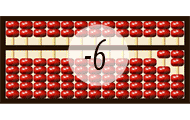
Each of the two beads of the upper deck of the abacus represents five units, and each of the five beads on the bottom deck of the rods is worth one unit. The beads in the rod at the far right represents the ones. The beads in the second rightmost rod matches the tens. The next rod represents the hundreds, and so on.In the lower deck, the beads get their values when they are moved upwards to the narrow strip, the beam. The beads in the upper deck get their values when they are moved down to the beam.
To switch on an abacus
When five beads have been counted in the lower deck, these are switched for one bead in the upper deck of the same rod. When two beads has been counted in the upper deck, these are switched for one bead in the lower deck of the rod to the left.Fingering
When using a real abacus, it is important to have the correct fingering. This means that the right index finger moves the beads above the beam and the right thumb moves the beads beneath the beam. In this game, it is only possible to have the correct fingering with an iPad or other touchpad. With a standard computer the beads are moved with the mouse.Connection to the curriculum
US: Common Core State Standards (CCSS)
- Grade 1 Extend the counting sequence.
- Grade 1 Count to 120, starting at any number less than 120. In this range, read and write numerals and represent a number of objects with a written numeral.
- Grade 1 The numbers 10, 20, 30, 40, 50, 60, 70, 80, 90 refer to one, two, three, four, five, six, seven, eight, or nine tens (and 0 ones).
- Grade 2 Understand that the three digits of a three-digit number represent amounts of hundreds, tens, and ones; e.g., 706 equals 7 hundreds, 0 tens, and 6 ones. Understand the following as special cases:
- Grade 2 The numbers 100, 200, 300, 400, 500, 600, 700, 800, 900 refer to one, two, three, four, five, six, seven, eight, or nine hundreds (and 0 tens and 0 ones).
- Grade 1 Understand that the two digits of a two-digit number represent amounts of tens and ones. Understand the following as special cases:
- Grade 1 Given a two-digit number, mentally find 10 more or 10 less than the number, without having to count; explain the reasoning used.
US: Texas Essential Knowledge and Skills (TEKS)
- Grade 2 The student applies mathematical process standards to understand how to represent and compare whole numbers, the relative position and magnitude of whole numbers, and relationships within the numeration system related to place value
- Grade 1 The student applies mathematical process standards to represent and compare whole numbers, the relative position and magnitude of whole numbers, and relationships within the numeration system related to place value
- Grade 3 The student applies mathematical process standards to represent and compare whole numbers and understand relationships related to place value
Connection clarified with Helpfulgames AI
Curriculum by level
1. Ones 1-4
The curriculum
US: Texas Essential Knowledge and Skills (TEKS)
- Grade 1 The student applies mathematical process standards to represent and compare whole numbers, the relative position and magnitude of whole numbers, and relationships within the numeration system related to place value
US: Common Core State Standards (CCSS)
- Grade 1 Extend the counting sequence.
- Grade 1 Count to 120, starting at any number less than 120. In this range, read and write numerals and represent a number of objects with a written numeral.
2. Ones 1-9
The curriculum
US: Texas Essential Knowledge and Skills (TEKS)
- Grade 1 The student applies mathematical process standards to represent and compare whole numbers, the relative position and magnitude of whole numbers, and relationships within the numeration system related to place value
US: Common Core State Standards (CCSS)
- Grade 1 Extend the counting sequence.
- Grade 1 Count to 120, starting at any number less than 120. In this range, read and write numerals and represent a number of objects with a written numeral.
3. Tens 10-40
The curriculum
US: Texas Essential Knowledge and Skills (TEKS)
- Grade 1 The student applies mathematical process standards to represent and compare whole numbers, the relative position and magnitude of whole numbers, and relationships within the numeration system related to place value
- Grade 2 The student applies mathematical process standards to understand how to represent and compare whole numbers, the relative position and magnitude of whole numbers, and relationships within the numeration system related to place value
US: Common Core State Standards (CCSS)
- Grade 1 The numbers 10, 20, 30, 40, 50, 60, 70, 80, 90 refer to one, two, three, four, five, six, seven, eight, or nine tens (and 0 ones).
- Grade 1 Given a two-digit number, mentally find 10 more or 10 less than the number, without having to count; explain the reasoning used.
4. Tens 10-90
The curriculum
US: Texas Essential Knowledge and Skills (TEKS)
- Grade 1 The student applies mathematical process standards to represent and compare whole numbers, the relative position and magnitude of whole numbers, and relationships within the numeration system related to place value
- Grade 2 The student applies mathematical process standards to understand how to represent and compare whole numbers, the relative position and magnitude of whole numbers, and relationships within the numeration system related to place value
US: Common Core State Standards (CCSS)
- Grade 1 The numbers 10, 20, 30, 40, 50, 60, 70, 80, 90 refer to one, two, three, four, five, six, seven, eight, or nine tens (and 0 ones).
5. Hundreds 100-400
The curriculum
US: Texas Essential Knowledge and Skills (TEKS)
- Grade 2 The student applies mathematical process standards to understand how to represent and compare whole numbers, the relative position and magnitude of whole numbers, and relationships within the numeration system related to place value
- Grade 3 The student applies mathematical process standards to represent and compare whole numbers and understand relationships related to place value
US: Common Core State Standards (CCSS)
- Grade 2 The numbers 100, 200, 300, 400, 500, 600, 700, 800, 900 refer to one, two, three, four, five, six, seven, eight, or nine hundreds (and 0 tens and 0 ones).
6. Hundreds 100-900
The curriculum
US: Texas Essential Knowledge and Skills (TEKS)
- Grade 2 The student applies mathematical process standards to understand how to represent and compare whole numbers, the relative position and magnitude of whole numbers, and relationships within the numeration system related to place value
- Grade 3 The student applies mathematical process standards to represent and compare whole numbers and understand relationships related to place value
US: Common Core State Standards (CCSS)
- Grade 2 The numbers 100, 200, 300, 400, 500, 600, 700, 800, 900 refer to one, two, three, four, five, six, seven, eight, or nine hundreds (and 0 tens and 0 ones).
7. Ones and tens 1-99
The curriculum
US: Texas Essential Knowledge and Skills (TEKS)
- Grade 1 The student applies mathematical process standards to represent and compare whole numbers, the relative position and magnitude of whole numbers, and relationships within the numeration system related to place value
- Grade 2 The student applies mathematical process standards to understand how to represent and compare whole numbers, the relative position and magnitude of whole numbers, and relationships within the numeration system related to place value
US: Common Core State Standards (CCSS)
- Grade 1 Understand that the two digits of a two-digit number represent amounts of tens and ones. Understand the following as special cases:
8. Tens and hundreds 100-990
The curriculum
US: Texas Essential Knowledge and Skills (TEKS)
- Grade 2 The student applies mathematical process standards to understand how to represent and compare whole numbers, the relative position and magnitude of whole numbers, and relationships within the numeration system related to place value
- Grade 3 The student applies mathematical process standards to represent and compare whole numbers and understand relationships related to place value
US: Common Core State Standards (CCSS)
- Grade 2 Understand that the three digits of a three-digit number represent amounts of hundreds, tens, and ones; e.g., 706 equals 7 hundreds, 0 tens, and 6 ones. Understand the following as special cases:
9. Ones, tens and hundreds 1-999
The curriculum
US: Texas Essential Knowledge and Skills (TEKS)
- Grade 2 The student applies mathematical process standards to understand how to represent and compare whole numbers, the relative position and magnitude of whole numbers, and relationships within the numeration system related to place value
- Grade 3 The student applies mathematical process standards to represent and compare whole numbers and understand relationships related to place value
US: Common Core State Standards (CCSS)
- Grade 2 Understand that the three digits of a three-digit number represent amounts of hundreds, tens, and ones; e.g., 706 equals 7 hundreds, 0 tens, and 6 ones. Understand the following as special cases:
Connection clarified with Helpfulgames AI
Knowledge Points and Medals
Calculation of knowledge points
Each completed game level in Abacus - Basics gives 1 knowledge points. You can collect a maximum of 9 knowledge points by completing all 9 levels.
In the game Abacus - Basics, you can earn a total of 27 medals. Medals are awarded based on how many times you have completed a level:
- Bronze medal: after completing 2 rounds.
- Silver medal: after completing 5 rounds.
- Gold medal: after completing 10 rounds.
Knowledge points are only awarded for levels you have not completed before, meaning those that do not yet have checked green circles. Even after completing a level and earning both knowledge points and medals, you can continue practicing it. However, this will not grant any additional knowledge points or medals.
Additional game information
Recent activities in this game
Someone got all questions correct at level 5. Hundreds 100-400 .
2 hours ago after 33 seconds of playing.
Someone got all questions correct at level 5. Hundreds 100-400 .
2 hours ago after 27 seconds of playing.
Someone got all questions correct at level 4. Tens 10-90 .
2 hours ago after 3 minutes of playing.
Someone got all questions correct at level 4. Tens 10-90 .
2 hours ago after 1 minute of playing.
Someone got all questions correct at level 3. Tens 10-40 .
2 hours ago after 19 seconds of playing.
Show more activities (10)
Someone got all questions correct at level 3. Tens 10-40 .
2 hours ago after 13 seconds of playing.
Someone had a problem at level 3. Tens 10-40 .
2 hours ago after 31 seconds of playing.
Someone got all questions correct at level 2. Ones 1-9 .
2 hours ago after 40 seconds of playing.
Someone got all questions correct at level 2. Ones 1-9 .
2 hours ago after 48 seconds of playing.
Someone got all questions correct at level 1. Ones 1-4 .
2 hours ago after 17 seconds of playing.
Someone got all questions correct at level 1. Ones 1-4 .
2 hours ago after 15 seconds of playing.
Someone got all questions correct at level 1. Ones 1-4 .
2 hours ago after 26 seconds of playing.
Someone had a problem at level 1. Ones 1-4 .
4 hours ago after 2 minutes of playing.
Someone had a problem at level 1. Ones 1-4 .
4 hours ago after 9 seconds of playing.
Someone got all questions correct at level 1. Ones 1-4 .
5 hours ago after 34 seconds of playing.
Found a mistake in the game?
If you find a spelling mistake or something else that should be corrected, feel free to contact the game creator or us at Helpful Games.
Rating
Comments
Log in to write a comment.
There are a total of 24 comments on this knowledge game.
B
19 October 2026 08:27
17 January 2026 08:25
25 March 2025 11:19
31 July 2024 10:26
A
9 May 2023 14:26
22 May 2022 12:14
J
12 February 2022 14:10
16 September 2021 17:04
10 September 2021 16:10
P
9 September 2021 05:50
4 June 2021 16:28
5 May 2021 15:25
D
4 March 2021 09:03
6 December 2020 18:42
W
22 July 2020 13:32
11 February 2020 07:09
S
11 January 2020 15:52
J
2 October 2019 20:08
27 August 2019 18:56
27 August 2019 18:53
21 June 2019 13:02
B
6 April 2019 21:50
7 February 2019 22:59
3 June 2014 19:18